Oil & Gas
Consumer Group Petitions over Dangote Kenya Refinery Deal
Scrutiny of Dangote's Kenya refinery deal follows a pattern set by the collapsed Adani contracts, where transparency concerns proved costly only after the ink had dried.
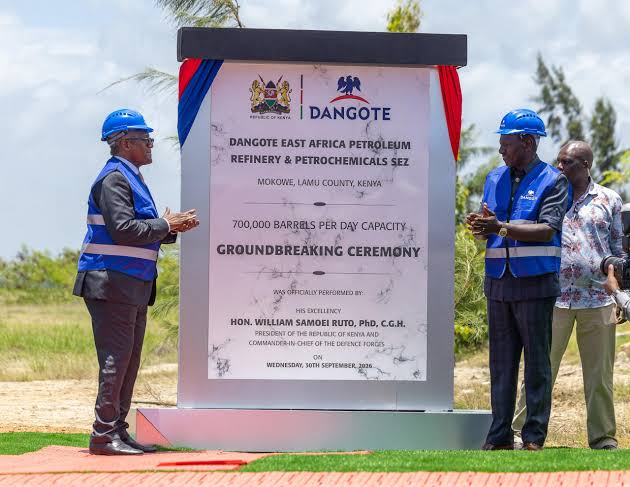
A Kenyan consumer rights group has petitioned a government panel over the approval process and proposed state investment in Aliko Dangote's $16 billion Lamu oil refinery, Consumers Federation of Kenya Secretary-General Stephen Mutoro disclosed in a post on X on Friday.
The federation filed its petition before the Public Private Partnerships Petition Committee under Section 75 of Kenya's Public Private Partnerships Act, 2021, seeking details of the contracting authority, procurement process and approvals for the refinery, along with records relating to its appraisal, due diligence and legal clearance.
The group is also seeking clarification on a reported KSh21.5 billion seed allocation and Kenya's proposed 10% stake in the project, said to be valued at about $500 million, asking the committee to distinguish between funds that have been budgeted, committed and actually disbursed by the government.
It further wants details of the vehicle through which Kenya would acquire its stake, the class of shares involved, and the proposed payment terms, as well as clarity on potential government commitments around petroleum-product offtake, market protection and electricity supply, and the contingent liabilities these could create for taxpayers and consumers.
The scrutiny echoes Kenya's Adani fallout
The petition lands against the backdrop of a bruising recent history for large, privately negotiated infrastructure deals in Kenya.
In November 2024, President William Ruto cancelled more than $2.5 billion in public-private partnership contracts with India's Adani Group, including a $1.85 billion, 30-year lease to upgrade and operate Jomo Kenyatta International Airport and a $736 million deal to build power transmission lines, after the conglomerate's billionaire founder, Gautam Adani, was indicted in the United States on bribery and fraud charges.
Both deals had already drawn sustained criticism from lawmakers, lawyers and civil society over a lack of transparency and competitive bidding before the indictment forced their collapse; the airport deal, which Adani proposed outside standard procurement procedures, only became public through a social media leak.
The cancelled transmission line deal has since left Kenya facing a potential Sh7.3 billion compensation bill, according to Treasury disclosures, a cost the Auditor-General has linked to broader financial mismanagement at the state transmission company involved.
That episode has made Kenyan civil society groups considerably more attentive to the fine print of major infrastructure partnerships, and the consumer federation's petition over Dangote's refinery reflects the same instinct to demand documentation upfront rather than after a deal is signed.
Mutoro said the federation has requested production of the relevant records within seven days, with authorities expected to indicate where any requested record does not exist.
The group is also asking the committee to set aside any approval found non-compliant with the law and remit the matter for reconsideration following appraisal, due diligence and conflict checks.
A separate land dispute is already before the courts
The consumer federation's petition comes days after 133 residents of Lamu approached a Kenyan court over land earmarked for the refinery in the Hindi/Manda Magogoni area, with a status quo order reportedly issued on September 25.
Mutoro said the land case is separate from the consumer group's petition, meaning the refinery now faces two distinct legal challenges running in parallel, one over land rights and compensation, the other over the transparency of the government's own investment process.
The developments follow the September 30 groundbreaking ceremony at which Ruto and Dangote formally launched the project.
Speaking to the BBC ahead of the ceremony, Dangote dismissed the land protests as the work of local marketers and international players opposed to the refinery, and said he was prepared to defend his business interests.
"To come and say some people are demonstrating, demonstrating about what? Have you ever seen people demonstrating against themselves in terms of development?" he said.
The refinery, expected to have a processing capacity of 700,000 barrels per day and a 1,000-megawatt power plant, is scheduled for completion in 2030 and is set to become Kenya's largest infrastructure project since independence, as well as Dangote's biggest investment outside Nigeria.
Dangote has offered regional governments a combined 30% stake in the project, according to Reuters.
How the Public Private Partnerships Petition Committee responds to the federation's documentation request within the requested seven-day window is likely to shape whether the dispute over Kenya's proposed stake is resolved quickly or escalates into the kind of prolonged legal and public scrutiny that ultimately unravelled the Adani agreements.
Related Stories

Sign up for our newsletter.
Get the latest news, expert analysis, and industry insights delivered straight to your inbox. Join thousands of professionals shaping the future of energy.
By submitting my information, I agree to the Privacy Policy and Terms of Service.