Oil & Gas
Dangote Refinery Powers Nigeria's Petroleum Export Breakthrough
The refinery's ability to supply overseas markets during global supply disruptions is strengthening confidence in Nigeria's manufacturing capacity and industrial ambitions.
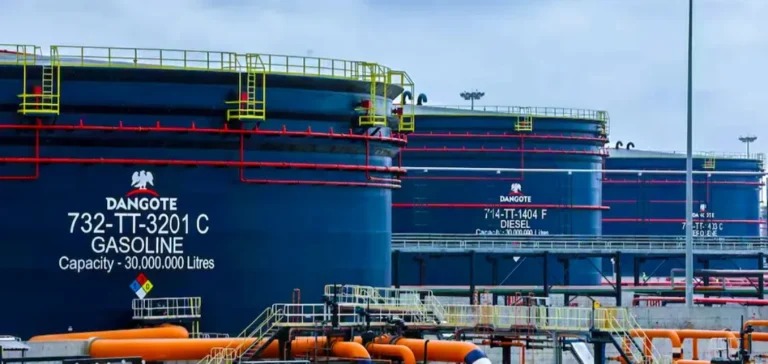
Nigeria exported refined petroleum products to international markets during global supply disruptions through the Dangote Petroleum Refinery, marking a major shift in the country's oil industry.
Minister of State for Industry, Senator John Owan Enoh, disclosed this on Wednesday after leading a high level delegation on a tour of the refinery, petrochemicals and fertiliser complex in Lagos.
He said the development has changed global perception of Nigeria and shows how local refining can support the country's ambition of building a one trillion dollar economy.
The refinery inspection followed the unveiling of the Nigeria Industrial Policy earlier this year. The visit gave ministry directors, regulators and heads of agencies an opportunity to assess how large manufacturing projects can strengthen local production, increase exports and support economic growth.
Export success changes Nigeria's position
Enoh said the Dangote refinery has transformed Nigeria from a country known for importing refined petroleum products into one that now supplies international markets.
He said Nigeria exported petroleum products to markets in the Middle East and other destinations when global supply chains were disrupted. He said the achievement demonstrates the value of refining crude oil locally instead of depending mainly on imported fuel.
"The more a country adds value to its products, the more respect it earns globally. The Dangote Refinery stands today as one of the strongest demonstrations of that principle," Enoh said.
He noted that the integrated refinery, petrochemicals and fertiliser complex is one of the biggest industrial investments in Africa and reflects the type of manufacturing needed to strengthen Nigeria's economy.
The minister said the visit also gave government officials a better understanding of the facility's technology, operations and strategic importance. He said members of the delegation left with greater knowledge and a stronger commitment to supporting industrial development.
Enoh also dismissed worries about the refinery's single train configuration. He said production continued during scheduled maintenance, giving the delegation a clearer understanding of how the plant operates.
He pledged continued engagement between the ministry and Dangote Industries Limited through the Industrial Revolution Work Group and ministerial roundtables to tackle challenges facing manufacturers, especially access to affordable long term financing.
The minister also commended Aliko Dangote for supporting the launch of the Nigeria Industrial Policy. The policy aims to increase manufacturing's contribution to Nigeria's Gross Domestic Product to about 20 per cent by 2030 and 25 per cent by 2035.
Dangote urges stable policies for industry
President and Chief Executive of Dangote Industries Limited, Aliko Dangote, said industrialisation must remain at the centre of Nigeria's economic strategy because no country achieves prosperity without a strong manufacturing sector.
He said successful indigenous businesses give confidence to foreign investors by showing that Nigeria can support major investments.
"The greatest attraction for foreign investors is the success of domestic investors. When local investors thrive, they send a powerful signal that the environment is conducive for investment," Dangote said.
He disclosed that Dangote Industries recently secured an unsecured and unrated bond below Nigeria's sovereign benchmark. He said the successful fundraising showed that Nigerian companies can attract long term capital when government policies are stable and predictable.
Dangote stressed that policy consistency is more important to investors than incentives because frequent policy reversals weaken investor confidence.
Reflecting on the refinery project, he said it was the biggest business risk of his life. He recalled that many financiers doubted the project would be completed and that it also faced challenges linked to the COVID 19 pandemic and foreign exchange volatility.
Dangote said completing the refinery proves that Nigerian entrepreneurs can deliver projects of global scale. He disclosed that, at full capacity, the refinery will account for the equivalent of about 10 per cent of the refining capacity of the United States and consume about 2.5 per cent of globally traded crude oil.
He urged the government to continue supporting indigenous investors, saying they play an important role in Nigeria's long term economic resilience.
Related Stories
Sign up for our newsletter.
Get the latest news, expert analysis, and industry insights delivered straight to your inbox. Join thousands of professionals shaping the future of energy.
By submitting my information, I agree to the Privacy Policy and Terms of Service.