Oil & Gas |Policy & Governance
NNPCL Signs Gas Infrastructure MoU with Chinese, Singaporean Firms
Nigeria’s national oil company signed a gas cooperation MoU with Chinese partners covering LNG, flaring reduction and gas-to-power projects as the country targets 12 bcf/d gas output by 2030.
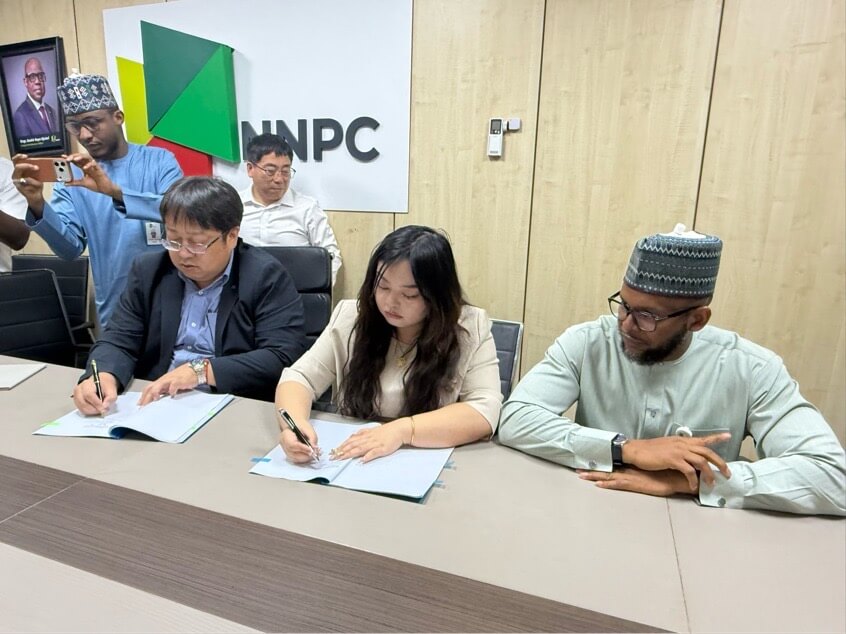
The Nigerian National Petroleum Company Limited (NNPC) has signed a tripartite Memorandum of Understanding(MoU), with China Gas Holdings Limited and Peiyang Chemical Singapore PTE Ltd. (PCCS), aiming to strengthen Nigeria’s natural gas sector and industrial energy capacity.
The agreement, signed at NNPC’s headquarters in Abuja, on Monday February 16, was witnessed by the company’s Group Chief Executive Officer, Bayo Ojulari; Executive Vice President for Gas, Power & New Energy Olalekan Ogunleye; and General Manager of NNPC Gas & Power Investment Services Ibrahim Hamza. PCCS Managing Director Tim Tian described the MoU as a framework for structured collaboration across the country’s gas value chain.
Under the terms, the three parties will explore initiatives spanning flare-gas-to-liquefied natural gas (LNG), floating LNG, and onshore LNG projects, as well as gas-fired power generation and industrial facilities using domestic gas feedstock. The MoU is intended to align international technical expertise with Nigeria’s domestic energy priorities and provide a governance structure to move projects from feasibility studies to commercial operations.
“Our role is to combine proven modular engineering with locally grounded commercial structures that make projects investible and deliverable,” PCCS Managing Director Tim Tian said, emphasising that accelerating scalable gas infrastructure is vital to generating jobs, reliable power, and industrial growth.
Following the signing, the Chinese delegation visited several operational facilities across Nigeria, including compressed natural gas (CNG) stations in Lagos and Shagamu, and met with energy sector stakeholders to discuss project delivery, integration with refinery operations, and potential financing structures through the Ministry of Finance Incorporated.
Nigeria holds the largest proven gas reserves in Africa and ranks among the top ten globally, yet remains one of the world’s leading gas-flaring countries due to infrastructure gaps that limit gas capture and utilisation ,a gap the new cooperation is expected to address.
Gas development has been positioned as a core federal priority under the Decade of Gas Initiative launched in 2021 to expand domestic consumption, support industrial growth and reduce routine flaring, with regulatory backing reinforced under the Petroleum Industry Act (PIA) 2021.
Implementation of gas commercialisation and flaring reduction policies continues through the Nigerian Upstream Petroleum Regulatory Commission (NUPRC), which oversees the Nigeria Gas Flare Commercialisation Programme (NGFCP) aimed at accelerating the utilisation of associated gas from upstream oil operations.
The cooperation also aligns with Nigeria’s Gas Master Plan targeting production of about 12 billion cubic feet per day (bcf/d) by 2030 and broader plans to increase domestic gas utilisation across power generation, industry and export markets.
Related Stories
Sign up for our newsletter.
Get the latest news, expert analysis, and industry insights delivered straight to your inbox. Join thousands of professionals shaping the future of energy.
By submitting my information, I agree to the Privacy Policy and Terms of Service.