Oil & Gas
Oil Output to Lift Nigeria’s 2026 Growth, Expand Economy — NESG
Improved crude production and domestic refining are expected to support a 4.2 per cent expansion of the economy this year.
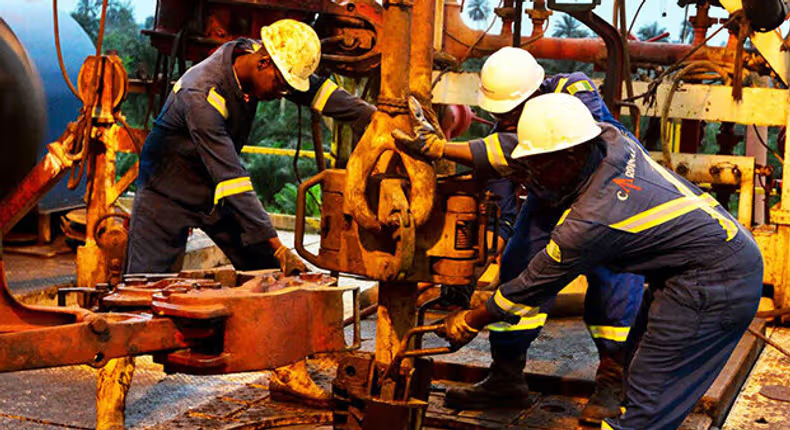
Nigeria’s oil sector is expected to provide a major lift to economic expansion in 2026 as improved crude production and upstream reforms help the country head towards a projected 4.2 per cent growth rate, the Nigerian Economic Summit Group has said.
The NESG, in its first-half 2026 State of the Economy report released on Wednesday, projected that gross domestic product would expand by about 4.5 per cent in the second half of the year, helping to produce full-year growth of about 4.2 per cent.
The report, titled Turning Potential into Progress, placed oil among the sectors expected to improve economic performance, alongside manufacturing, agriculture and services.
The think tank said better security conditions and the gradual implementation of reforms in the upstream petroleum industry would support higher domestic crude oil production through the rest of the year.
It also projected that increased refining of crude within Nigeria would support industrial activity and reduce the country’s dependence on imported refined petroleum products.
The anticipated rise in domestic refining could also improve Nigeria’s external position, the group said, as more locally produced fuel replaces products brought into the country from abroad.
Oil recovery faces risks
The NESG said the outlook for oil production offered one of the major opportunities for growth to exceed its current projection.
A stronger-than-expected recovery in the oil industry, together with higher foreign capital inflows and faster implementation of structural reforms, could produce economic growth above 4.2 per cent in 2026.
But the report warned that several domestic and external factors could weaken the outlook.
Among them are global economic and geopolitical shocks, political uncertainty connected with preparations for the 2027 general elections, insecurity and climate-related disruptions.
The group warned that a slowdown in the global economy, renewed trade tensions and tighter international financial conditions could hurt Nigeria’s export earnings and foreign exchange inflows.
Such developments could also limit government revenue and place pressure on the exchange rate.
The NESG further warned that heightened political activity ahead of the 2027 elections could affect the continuation of reforms and place fiscal discipline under pressure through higher pre-election spending.
However, the report, for the oil sector, identified improved security and upstream policy implementation as conditions supporting better crude production.
Refining expected to support industry
Apart from crude production, the NESG projected that domestic refining activity would contribute to industrial output during the year.
The group also expects manufacturing to maintain expansion as lower inflation, exchange rate stability and better access to foreign exchange ease some production difficulties and improve business confidence.
It said, “Moreover, manufacturing activity is expected to sustain growth momentum as lower inflation, continued exchange rate stability, and improved foreign exchange liquidity ease production constraints and strengthen business confidence.”
Manufacturers, however, still face unreliable electricity supply, high borrowing costs, expensive logistics and weak domestic demand.
The report projected that agriculture could benefit from improved rainfall and favourable harvest conditions, supporting crop production and food supply. Insecurity in major food-producing areas and flooding could, however, reduce expected gains.
The services sector is expected to make the largest contribution to economic expansion, with financial services benefiting from bank recapitalisation, improved credit intermediation and better investor confidence.
Related Stories


Sign up for our newsletter.
Get the latest news, expert analysis, and industry insights delivered straight to your inbox. Join thousands of professionals shaping the future of energy.
By submitting my information, I agree to the Privacy Policy and Terms of Service.