Climate & Sustainablity
Climate Change Fuels Tougher Wildfire Conditions as Algeria Counts 12 Dead
Repeated fires in northern Algeria have killed at least 12 people and closed three national highways, amid hot, dry conditions associated with climate change.
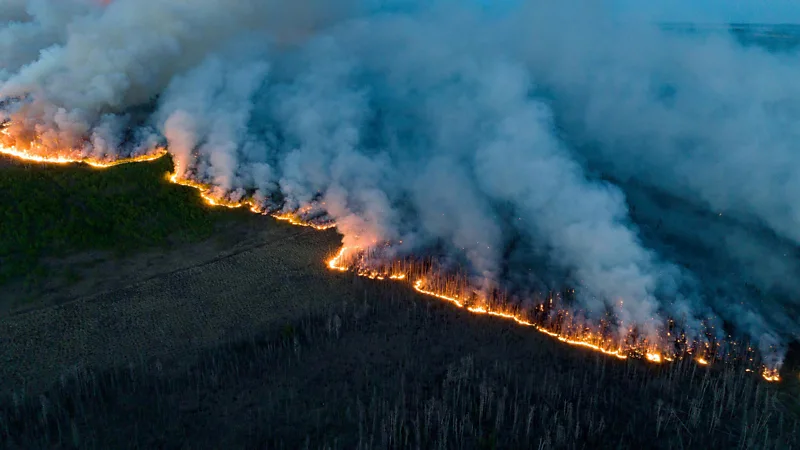
At least 12 people have died in severe wildfires in northern Algeria, where flames have reached homes, farmland and transport routes, exposing the danger posed by hotter and drier conditions associated with climate change. The fires struck Jijel, Béjaïa and Tizi Ouzou in late August, forcing the emergency closure of three national highways.
The fires form part of a difficult summer for Algeria, which recorded nearly 2,000 fires nationwide in July. In the northeastern province of Annaba, fires at the end of that month forced more than 100 people from their homes and damaged nearly 150 houses.
The repeated outbreaks show how prolonged heat and drought can create conditions in which vegetation dries out and fires spread quickly. Northern Algeria regularly experiences forest fires during summer, but increasingly frequent drought and periods of intense heat are contributing to more severe fire conditions.
The danger is not limited to forests or rural land. Once flames reach settlements, roads and other built-up areas, the effects quickly become a problem for people, homes and transport.
Hotter, drier conditions raise fire risks
The Algerian fires are part of a much larger pattern of fire activity recorded in 2026. Data from the Global Wildfire Information System, compiled by Our World in Data, showed that 112.3 million hectares had burned globally as of August 1.
Africa accounted for 55.1 per cent of the burned area. The Democratic Republic of Congo recorded 13.6 million hectares, followed by Australia with 11.8 million hectares and Angola with 7.5 million hectares.
The figures need to be read with care. They include agricultural and prescribed burning, so they do not show the exact size of land affected by uncontrolled wildfires.
Still, the geographical scale of the fires shows how heat, dryness and vegetation conditions can create serious risks in different parts of the world. Climate change is associated with increasingly hot and dry conditions, and the combination of high temperatures, drought and dry vegetation can allow fires to spread faster and become harder to contain.
Europe has also recorded significant fire activity this year. Data from the European Forest Fire Information System showed that 634,473 hectares had burned in the European Union by August 27 in fires larger than 30 hectares.
That figure is lower than the 984,559 hectares recorded during the same period in 2025. But it is more than twice the 2006 to 2025 average of 313,246 hectares.
EFFIS forecasts very extreme fire conditions in isolated areas of central Europe and the Balkans, Portugal, eastern Spain and the Atlas Mountains of North Africa. Extreme danger also extends through parts of southeastern Europe towards Ukraine.
For August 31 to September 6, the forecast points to above-average temperatures over the Iberian Peninsula and North Africa. Below-average rainfall is also forecast in parts of the Iberian Peninsula, France, Italy and the Balkans.
Fires are reaching homes and vital roads
Spain has recorded one of Europe's most severe fire seasons this year, with about 226,391 hectares burned by August 1. France has also faced major fires, with simultaneous fires in the two countries leading to mass evacuations.
In the United Kingdom, fires have affected areas including the Cairngorms. Other European communities have also faced smoke, evacuations and damage to homes and infrastructure.
The pattern stretches beyond Europe and North Africa. Canada had recorded about two million hectares burned by August 1, with fires in several provinces forcing communities to evacuate and sending smoke into parts of Canada and the United States.
The United States had recorded about 2.4 million hectares burned by the same date, with major fires reported in Oregon, Washington and Idaho. Australia had recorded about 11.8 million hectares burned.
For people living near fire-prone areas, the immediate danger is often simple and direct. Homes can be damaged or destroyed, residents may have to leave at short notice, roads can become unsafe and smoke can affect daily life.
Algeria's highway closures show another problem. Roads that normally support movement between towns can suddenly become emergency routes or become unusable because of fire.
The damage can also affect the return of residents after an evacuation. Where homes, roads and other infrastructure have been damaged, communities face the difficult task of restoring normal life.
The Algerian experience also shows why climate change cannot be viewed only as a question of rising temperatures. Its effects can appear through the conditions that make extreme fires easier to start, spread and contain.
The 2026 fire season has recorded large areas of burned land in Africa, Europe, North America and Australia. In Algeria, the human cost has already included at least 12 deaths, the displacement of more than 100 people in Annaba and damage to nearly 150 houses there.
Related Stories
Sign up for our newsletter.
Get the latest news, expert analysis, and industry insights delivered straight to your inbox. Join thousands of professionals shaping the future of energy.
By submitting my information, I agree to the Privacy Policy and Terms of Service.