Power
Ramokgopa Rules Out Eskom Bailouts, Outlines 'Eskom 2.0'
Eskom's shift from a century-old monopoly to a competitive market model hinges on resolving a R450 billion municipal debt crisis that predates the reform itself.
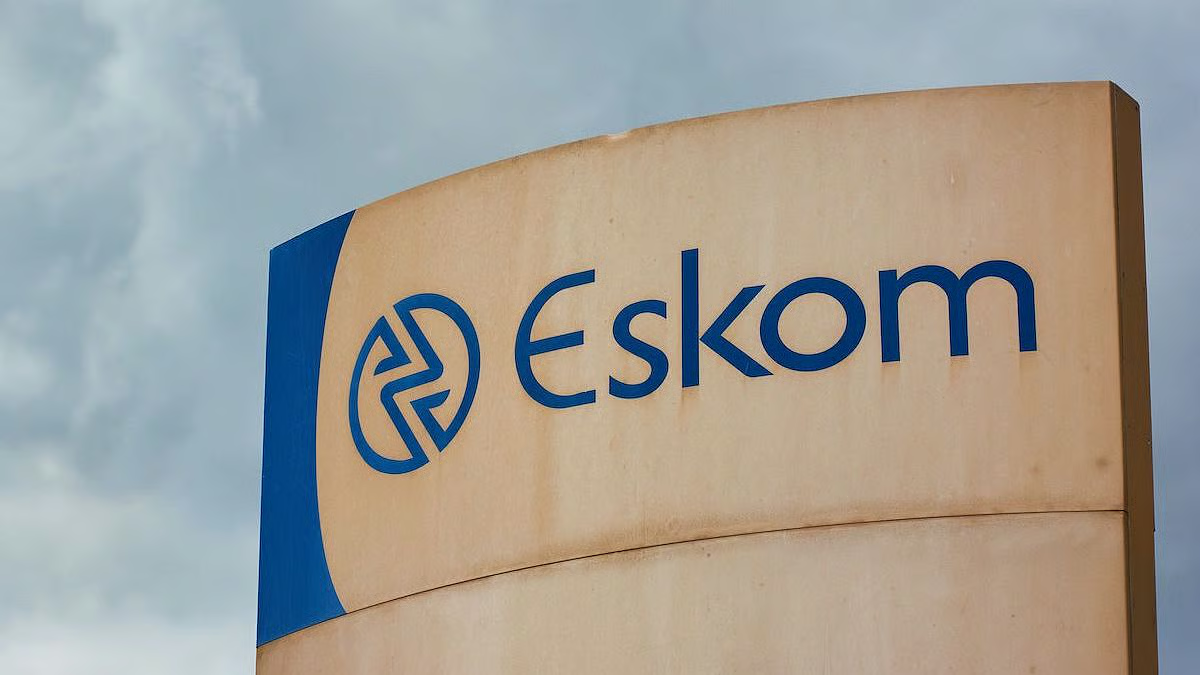
Electricity and Energy Minister Kgosientsho Ramokgopa has ruled out further government bailouts or double-digit tariff increases for Eskom, telling the utility's new board on Friday that it must undergo a fundamental transformation, described as "Eskom 2.0," as South Africa moves toward a more liberalised electricity market.
"There will not be any bailouts from government. There will not be double-digit electricity tariff increases in this country. It will not be happening, and for that, Eskom must prepare itself," Ramokgopa told journalists.
He said Eskom must instead improve plant performance, procurement, maintenance, project delivery and workforce productivity to remain financially viable.
Eskom must move away from its monopoly model
Ramokgopa emphasised that Eskom must shift away from its traditional vertically integrated structure as new generators, traders and distributors enter the market.
"We are moving away from a vertically integrated monopoly into one that has been liberalized, and there are multiple actors," he said.
Eskom has operated as a single, state-owned entity controlling generation, transmission and distribution since its founding in 1922, but government approved a plan in December to split the utility into separate entities, including the National Electricity Distribution Company of South Africa, a standalone Generation Company, the National Transmission Company South Africa, and a renewables-focused subsidiary, Eskom Green, alongside a fully independent transmission system operator.
The full separation is expected to be completed by 2030.
Ramokgopa said Eskom's recovery from load shedding gives it an opportunity to reposition for the future, but warned that the next phase of the energy transition could prove more complex than resolving load shedding itself.
He disclosed that the utility's future must be anchored by reliable and affordable electricity, economic growth, industrialisation and universal access, and that its board must produce a single roadmap covering Eskom's public mandate, commercial position and investment plans over the next three to five years.
Municipal debt remains a major financial threat
Ramokgopa said municipalities currently owe Eskom about R450 billion, with poor revenue collection at municipalities that hold their own electricity distribution licences adding further pressure.
He averred that government will work with National Treasury, the Department of Cooperative Governance and Traditional Affairs, and the South African Local Government Association to improve payment discipline and negotiate debt arrangements.
He added that Eskom must also address electricity theft, technical losses, inaccurate metering and weak revenue collection more broadly.
"Our intention of lowering the cost of electricity will not materialize, will not eventuate, for as long as Eskom is unable to address these inefficiencies," he said.
Transmission expansion to prioritise local manufacturing
Ramokgopa revealed that Eskom will also play a central role in South Africa's transmission expansion, with government planning to roll out about 14,500 kilometres of new transmission lines at an estimated cost of R440 billion.
He stated that the programme must create opportunities for local manufacturers rather than relying on imported components.
"We are not going to export jobs. We are not going to allow dumping of these components in the country," he said, adding that government is working with the Department of Trade, Industry and Competition to ensure procurement linked to the programme supports domestic manufacturing.
The minister said Eskom must also prepare for future electricity demand from sectors such as mining, industry and data centres, while expanding its presence in the wider Southern African region, with surplus generation capacity potentially opening opportunities to export electricity to neighbouring countries.
He said Eskom's new strategy must address the future of its coal fleet alongside renewable energy, gas and nuclear generation, and make greater use of artificial intelligence to improve forecasting, reduce technical losses and strengthen grid management.
Whether Eskom's new board can deliver the roadmap the minister has requested, while resolving the municipal debt crisis and completing the transmission build-out, is likely to determine how much of "Eskom 2.0" translates from stated intention into operational reality in the years ahead.
Related Stories
Sign up for our newsletter.
Get the latest news, expert analysis, and industry insights delivered straight to your inbox. Join thousands of professionals shaping the future of energy.
By submitting my information, I agree to the Privacy Policy and Terms of Service.